Ranking #1 on Google is no longer the ultimate goal of SEO. High rankings do not always bring more clicks, traffic or sales. In 2026, Google AI Overviews, AI Mode and zero-click searches are changing how people find information online. Users can now get answers without visiting a website.
The real goal of SEO is to improve search visibility, build trust and attract the right audience. Businesses must focus on search intent, helpful content, E-E-A-T, organic traffic and conversions. They should also track brand visibility across Google and AI-powered platforms.
A top ranking still matters, but it is only one part of SEO success. The real value comes from reaching the right people and turning visibility into meaningful results.
What Does Ranking #1 on Google Actually Mean in 2026?
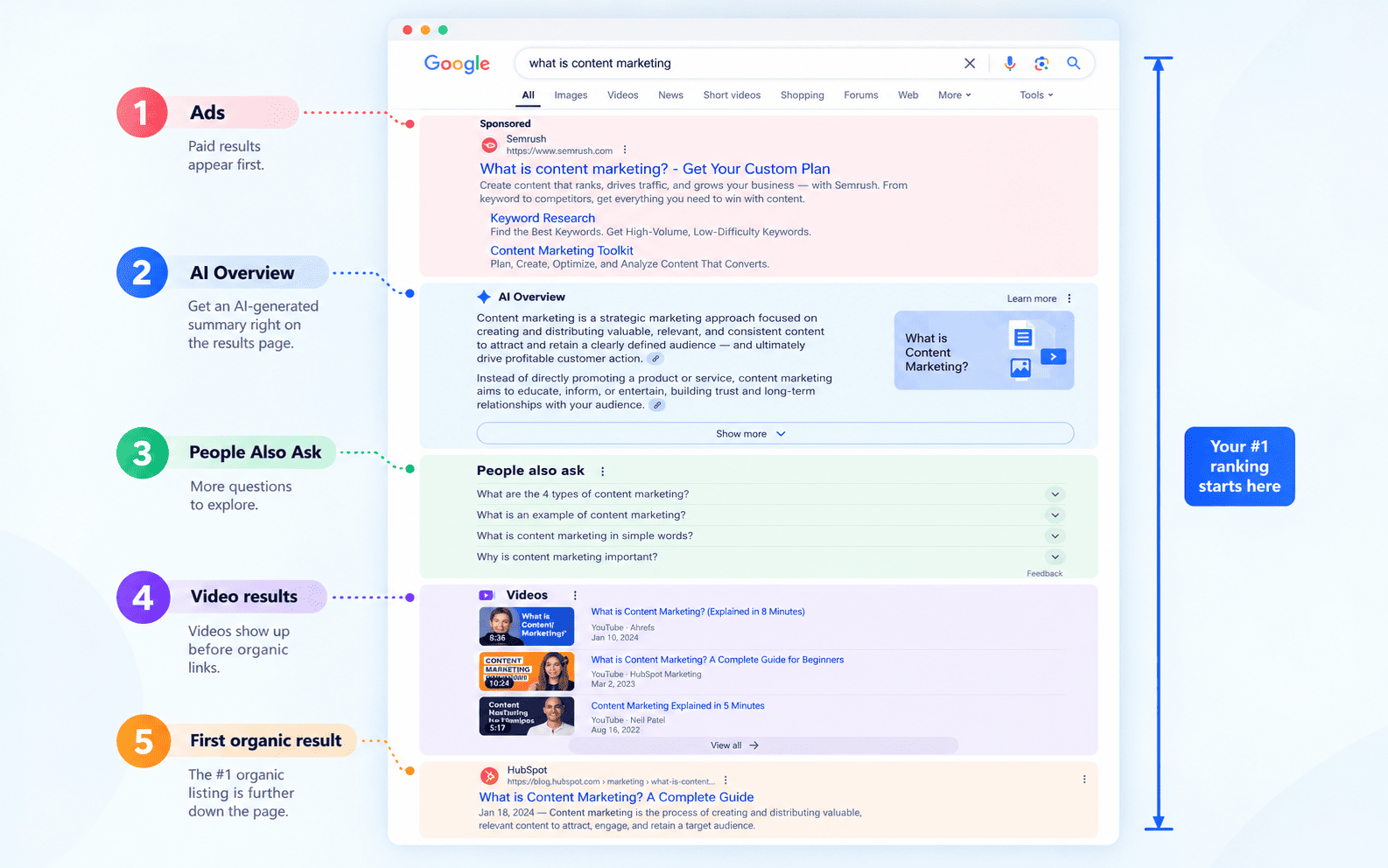
Ranking #1 means your webpage appears first in Google's organic search results for a specific query. However, high rankings do not guarantee more clicks or sales. AI Overviews and zero-click searches can reduce website visits.
SEO success in 2026 means reaching the right audience, building trust and generating conversions. Rankings are still important, but visibility, search intent and business results matter too.
This highlights three important differences:
- Ranking: Where a page appears in organic search results.
- Visibility: How often and where a brand or page is seen across relevant search experiences.
- Performance: Whether that visibility leads to useful visits, enquiries, sales or other business outcomes.
Why Ranking #1 on Google Is No Longer Enough
Ranking #1 on Google does not guarantee more traffic, leads or sales. AI search, zero-click searches and changing user behaviour affect how people discover websites.
1. Google AI Overviews
AI Overviews provide quick answers in search results. Users may get information without visiting your website. Create helpful content that answers specific questions.
2. Changing Search Results
Google displays AI answers, featured snippets, maps, videos and product listings. Optimise content for relevant search intent and formats.
3. Zero-Click Searches
Users can find answers without clicking a website. Track impressions, organic clicks, brand visibility and conversions to measure performance.
4. Search Intent
Users search to learn, compare or buy. Match your content to their needs to attract relevant traffic.
5. Conversions Matter
High rankings do not guarantee sales. Focus on qualified leads, conversion rates and revenue, not just website visits.
6. Multiple Discovery Platforms
People also discover brands through YouTube, LinkedIn, Reddit and AI assistants such as ChatGPT and Perplexity. Build visibility on platforms relevant to your audience.
Takeaway: SEO success in 2026 means improving search visibility, building trust and generating meaningful results not just ranking first on Google.
From Traditional SEO to Search Visibility
SEO success in 2026 goes beyond keyword rankings and organic traffic. It also includes search visibility, AI search visibility, brand awareness and conversions.
1 Organic Search Visibility
Track how often your website appears in Google’s organic search results. Use Google Search Console to monitor impressions, clicks, click-through rate (CTR) and average position across relevant keywords.
2 AI Search Visibility
Check whether your content appears in Google AI Overviews, Google AI Mode and AI assistants such as ChatGPT. Publish helpful, reliable content that answers user questions clearly. Track repeated queries over time because AI-generated answers can vary.
3 Brand Visibility
Track how often people discover and search for your brand. Monitor branded search queries, referral traffic, website mentions and direct visits. These signals can help you understand brand awareness beyond organic rankings.
4 Business Performance
Measure whether SEO generates meaningful results, such as:
- Qualified leads and enquiries
- Sales and revenue
- Product sign-ups and trials
- Newsletter subscriptions
- Relevant downloads and registrations
Takeaway: Modern SEO focuses on organic rankings, AI search visibility, brand discovery and business growth. Track these metrics together to understand how search visibility attracts the right audience and supports conversions.
Why E-E-A-T Matters for Search Visibility in 2026
E-E-A-T stands for Experience, Expertise, Authoritativeness and Trustworthiness. These principles help businesses create reliable, helpful content that meets user needs. Google does not treat E-E-A-T as a single ranking factor. Trust remains its most important element. Source: Google Search Central.
- Experience: Share first-hand knowledge, original examples, case studies and practical insights.
- Expertise: Provide accurate information and demonstrate subject knowledge through clear, useful content.
- Authoritativeness: Build industry recognition through credible references, expert contributions and original research.
- Trustworthiness: Support claims with reliable sources, transparent business details and accurate information.
Does E-E-A-T Improve AI Search Visibility?
Strong E-E-A-T principles support content quality and credibility. They do not guarantee citations in ChatGPT, Perplexity or Google AI Overviews. Focus on helpful content, technical SEO, clear answers and reliable sources to improve search visibility across relevant platforms.
Why Covering a Topic Matters More Than Repeating a Keyword
Semantic SEO focuses on search intent, related topics and entities. It helps businesses create comprehensive content that answers users’ questions without keyword stuffing.
Build a Connected Content Structure
Create supporting articles around your main topic. Cover related subjects such as Google rankings, AI Overviews, organic traffic, E-E-A-T and conversion optimisation. Use relevant internal links to connect related pages and build topical authority.
Use Natural Language and Related Questions
Include relevant keywords, semantic terms and common user questions naturally. Explain concepts clearly and avoid unnecessary repetition. Focus on content relevance rather than keyword density.
Make Answers Clear and Direct
Answer the main question early. Use descriptive headings, short paragraphs and practical examples to improve readability and search intent alignment.
Use Structured Data Correctly
Implement relevant schema markup, such as Article or Product, where appropriate. Ensure it matches visible content and follows Google’s guidelines. Structured data does not guarantee higher rankings or AI search citations.
How to Optimise Content for Google and AI Search Platforms
- Answer questions directly: Provide concise, relevant answers near the beginning of each section.
- Use descriptive headings: Organise content around search intent and related queries.
- Add reliable evidence: Include original insights, verified statistics and genuine case studies.
- Maintain technical SEO: Check crawling, indexing, internal links, mobile usability and page speed.
- Cover the customer journey: Address awareness, consideration, purchase and post-purchase questions.
- Repurpose useful content: Adapt articles into videos, newsletters and social media posts.
- Avoid AI SEO shortcuts: Review AI-generated content for accuracy, originality and usefulness.
Focus on helpful content, semantic relevance, technical accessibility and user experience to strengthen organic search visibility across Google and AI-powered search platforms.
The SEO Metrics That Matter Beyond Position #1
A broader SEO strategy requires a balanced set of measurements. The exact metrics depend on the purpose of the website, so not every business needs to track every figure.
|
Metric |
What it tells you |
Where to Track it |
|
Organic impressions |
How often eligible search results are shown |
Google Search Console |
|
Organic clicks |
How many clicks come from Google Search |
Google Search Console |
|
Average position |
The average position of a site's results in reported searches |
Google Search Console |
|
Click-through rate (CTR) |
The relationship between impressions and clicks |
Google Search Console |
|
Engaged sessions |
Visits that meet GA4's engagement criteria |
Google Analytics 4 |
|
Conversion rate |
The proportion of relevant visits completing a defined action |
Google Analytics 4 or your analytics system |
|
Qualified leads |
Enquiries that meet your sales criteria |
CRM or lead management system |
|
Revenue from organic sessions |
Sales associated with organic search under your chosen attribution model |
Ecommerce analytics or CRM |
|
Brand mentions in AI answers |
Whether selected AI systems mention or cite the brand for relevant prompts |
Manual checks or suitable monitoring tools |
|
Branded search demand |
Search interest in the company or product name |
Search Console and other research tools |
A Practical SEO Strategy for 2026
Businesses must adapt their SEO strategies to changing search behaviour. Focus on technical SEO, helpful content, organic visibility and conversions.
Step 1: Audit SEO Performance
Track organic traffic, impressions, clicks, conversions and qualified leads. Identify high-performing pages and areas for improvement.
Step 2: Research Search Intent
Analyse target keywords, customer questions and competitor content. Find content gaps and create relevant, user-focused answers.
Step 3: Optimise Existing Content
Update outdated information, improve headings and add relevant semantic keywords. Remove duplicate content and fill information gaps.
Step 4: Build Topical Authority
Publish useful content around your products, services and industry expertise. Use internal links to connect related pages and improve content discovery.
Step 5: Improve Search Visibility
Optimise crawling, indexing, page speed and mobile usability. Maintain accurate brand information and build credible online mentions.
Step 6: Track SEO Results
Use Google Search Console and Google Analytics 4 to monitor rankings, organic traffic, conversions and lead quality. Review performance regularly and adjust your strategy based on data.
A successful SEO strategy combines relevant content, technical optimisation, search intent and measurable business growth.
Common SEO Mistakes to Avoid
Avoid these common mistakes to improve search visibility and SEO performance in 2026.
- Focusing on one keyword: Track organic traffic, relevant queries and conversions, not just rankings.
- Writing to meet a word count: Focus on search intent and helpful content, not article length.
- Keyword stuffing: Use primary and semantic keywords naturally.
- Ignoring AI search visibility: Monitor relevant brand mentions and citations across AI platforms.
- Building irrelevant backlinks: Earn links through useful content and genuine industry relationships.
- Neglecting user experience: Improve page speed, readability, navigation and mobile usability.
- Publishing unchecked AI content: Verify facts, statistics and examples before publishing.
Takeaway: Focus on useful content, technical SEO, user trust and measurable results rather than shortcuts.
Conclusion
Ranking #1 on Google still matters, but it is not the only measure of SEO success. AI Overviews, zero-click searches, and changing user behaviour make search visibility more complex.
Businesses must focus on helpful content, search intent, E-E-A-T, organic traffic, brand authority, and conversions. A strong SEO strategy attracts qualified leads, improves engagement, and supports business growth. It also boosts visibility across Google and AI-powered search platforms.
Partner with WOWinfotech to improve your search visibility through quality content, relevant traffic, and measurable SEO results. Visit WOWinfotech to grow your online presence.
Frequently Asked Questions
Contact us to get a digital strategy
Contact us for digital strategy guidance.